
I thought we were doing quite well…
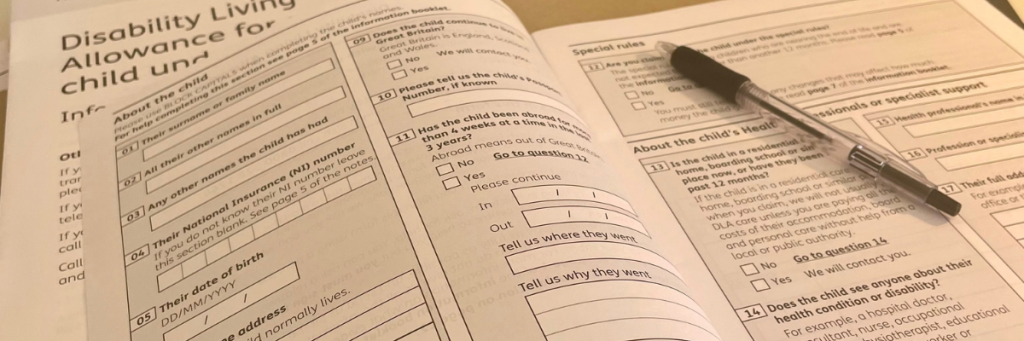
One of the things I’ve been spending quite a lot of time doing this week has been going through one of my children’s written observations, ready to complete their DLA renewal form.
And I think anybody who has been through this process will understand that completing a DLA form for your child is an incredibly emotionally draining thing to have to do.
It’s one of those things that many of us need to do because we’ve stepped back from work or careers to support our families and financially we need the extra support. Our children may need additional therapies, sensory aids and things that they quite simply can’t live without. And, if we want some semblance of peace in our lives, nor can we.
So we end up completing all of this paperwork on top of work, parenting, looking after the house, emails to and from school, and all the usual things that everybody tries to fit in.
Something I was advised to do many years ago was to keep written observations of anything that was potentially different from what you might expect to see from a similar-aged child.
It doesn’t need to be complicated. Just a short, factual observation with the date, what happened, what led to it and what the outcome was.
It’s probably one of the most helpful things I’ve ever been advised to do because those written observations form evidence. And that evidence is incredibly helpful, not just for DLA forms, but if you’re seeking diagnosis, trying to get an EHCP or really having any interaction with professionals where you’re trying to describe and explain what life actually looks like.
If there’s one thing I tend to suggest to anybody who comes to me earlier on in their journey and asks what their first steps should be, it’s to start making written observations.
They can be very, very short. I used to keep a scrap of paper and then update a document on the computer. You can use notes on your phone. Emails and communication to and from your school class and head teachers all form evidence too. It all builds a picture of what you and your child are dealing with as a family.
But back to the DLA form.
When you actually sit down to complete something like this, they understandably need to know the impact on you and your family, how much of your time is spent caregiving and what that actually looks like day to day.
And that can be quite gruelling work.
You’re using examples of your child in distress. You’re explaining what your days look like, what volatile moments, meltdowns or periods of high distress look like, what you need to do to support your child through them and the knock-on effect on the rest of the family.
Going through and updating my own observations over the past week or so has made me realise something.
I had actually considered that we were in quite a good place.
And I think, compared with a few years ago, we are.
But part of that is because I’ve become better at anticipating and meeting my children’s needs. Part of it is because, when things do bubble over and we’re dealing with very volatile moments, high distress or meltdowns, I’m much better at understanding how to react in the moment and how to support my child through them.
And part of it is simply that living this way has become very normal.
This is just our family.
I think you almost forget that not everybody lives with these situations. And it’s only when you sit down and start documenting them and using them as evidence that you suddenly notice the gap.
You notice the gap between your child and peers who aren’t on a similar path.
I think I’d also been feeling quite guilty recently. My children are still young enough to need me, but they’re starting to get a little older. We’re kind of at that middle stage now, and one has just started secondary school.
I’d started feeling that I should be able to do more. That perhaps I was being pulled back into the caring role too much. I even wondered whether I was mollycoddling a little.
But when I step back and look at these observations, I realise that none of those things are true.
I can see just how important my role as their mother, but also their carer and co-regulator, still is. I can see just how much time it takes and how much strain it can put on the family.
And I can understand why I’m so tired and emotionally drained.
That isn’t to complain or to paint my child in a negative way at all. It’s merely an acknowledgement that, whilst the challenges we face have changed over the years, there are still challenges.
My children still need a lot of support. A lot of scaffolding. A lot of co-regulation.
But actually, that’s okay.
Because I can also see how much progress has been made since I completed that first form a few years ago.
Their needs are still very high. They still need me a lot. But they need me in a different way than they used to.
And perhaps that’s something we need to acknowledge more as parent carers.
Firstly, when you see it all written down, just how much work goes into this role. How much you anticipate, adapt, scaffold, regulate, advocate and support, often without even consciously thinking about it anymore.
Give yourself some credit for that.
And secondly, if you’re going through one of these processes yourself, remember that it is emotionally draining. It is a lot. You don’t have to sit down and force yourself through the whole thing in one go.
Pace yourself. Work through it in sections and chunks if you need to.
And perhaps most importantly, remember that these forms are designed to focus on the difficulties. They ask us to look closely at the hardest parts of our children’s lives and our own.
So when you’ve put the paperwork down, remember to look at the other bits too.
Notice what has changed. Notice the progress that perhaps you don’t see when you’re living it every day. Notice the things that are easier now because both you and your child have learned and adapted.
And look for those glimmers. Those small moments of joy in the everyday.
Because the form might need you to document everything that is hard.
But that isn’t the whole story.